


Landscape Moon - Four-Channel Passive-Analog Drum Synth
Landscape Moon - Four-Channel Passive-Analog Drum Synth

Couldn't load pickup availability
-
Loyalty Reward Earn £7.18 in Loot Credits with this purchase.
-
UK shipping Price includes UK VAT. No hidden customs charges.
-
Loot Synergy 2% of your total order back in Loot Credits for use at lootaudio.com.
-
Authorized Retailer Official UK partner. Full manufacturer warranty.
Moon is a four-channel passive-analog drum synth that reimagines rhythm and control. Each of the channels is a unique analog circuit with its own characteristics, inspired by but different from those in the Noon. The Moon’s sound is heavier, rounder and darker. Activate and modulate Moon using voltage from external sequencers. No power supply needed. Analog circuits are powered momentarily by incoming gate and control voltage signals causing them to oscillate and move naturally. When Moon's channels are combined, they grow, inform and process one another in complex rhythmic ways. Momentary power increases the unstable properties and organic textures of analog circuits. The immediacy of simple controls allows for rapid alterations without patching.

How to use Moon
⨮ POWER: Moon is a passive instrument which relies on receiving control voltage (power) from external sources. A voltage sequencer, modular system or some form of external control voltage is required for use, and must be connected to any or all of Moon’s 4 channels. Using sequencers which have the ability to vary gate length is highly encouraged due to the increase in sound possibilities and rhythmic movement. Sequencers with USB power should be used with a USB wall adaptor because powering via a computer can create background noise in Moon.
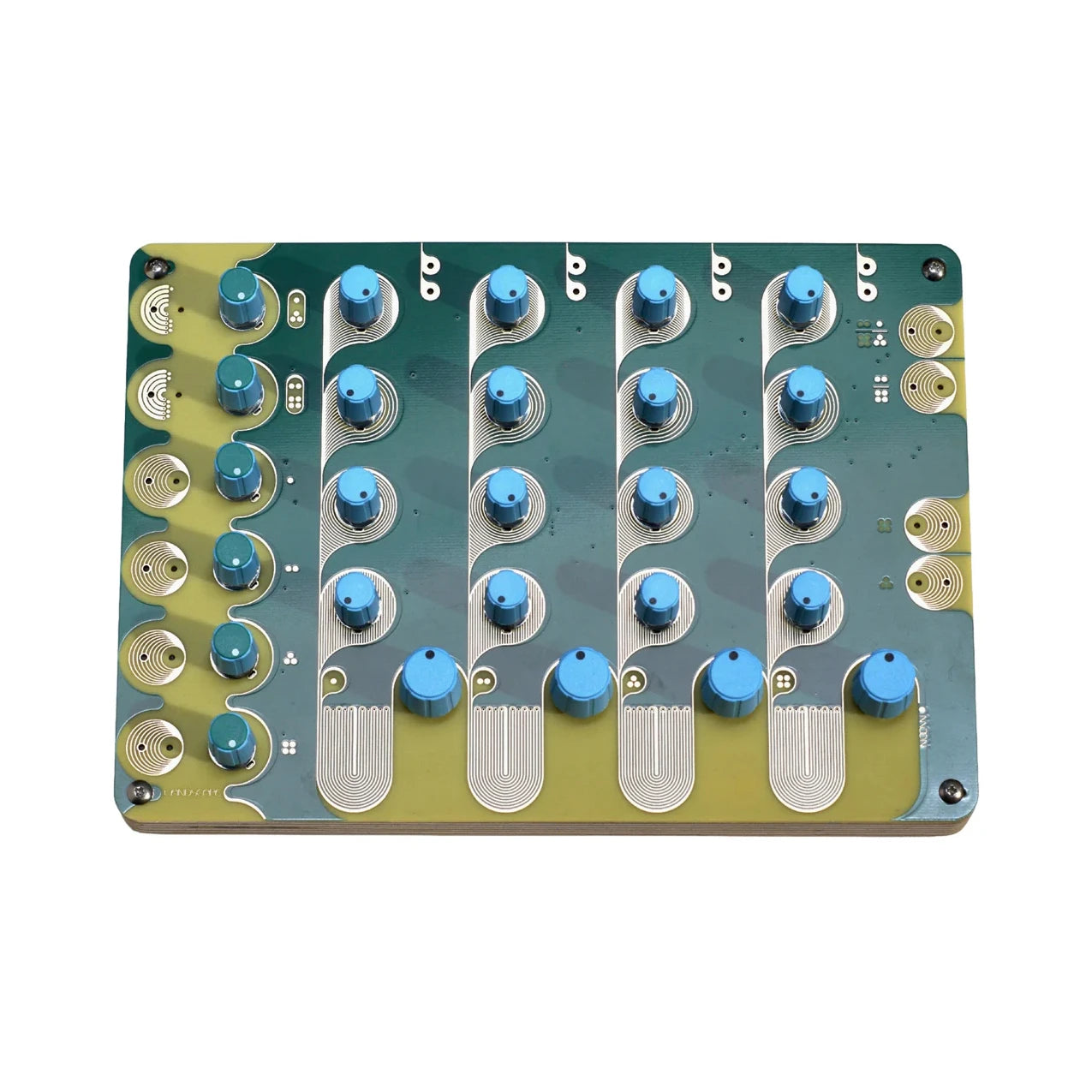
⩸ CHANNELS: Each of the 4 channels, demarcated on the interface by vertical sprouting plant shapes and corresponding number of dots, features a unique analog circuit which is powered and controlled directly from its respective (number of dots 1-4) gate input on the left side.
● Ch.1 / Ploymer: Distortion kicks, physical knocks, rim, jagged vocal bass, acid
● Ch.2 / Plas: Toms, zaps, snare-ish, plinks, wet kick, juicy bass
● Ch.3 / Laub: Taps, palm clap, sine sub-bass, clicks, rounded saw, env kick, filter ping, feedback filtering, distortion gate
● Ch.4 / Cys: Squish, toms, tap, juice, flutter, high noise, long decay, distortion gate

⇅ CHANNEL 1-4 KNOBS: Each channel features a vertical row of four knobs. The parameters of each knob are different from channel to channel and can be quickly learned through use and experimentation. Generally they will control pitch, texture, decay, filter cutoff, and brightness. However, the response of these controls changes somewhat based on what types of control voltages are incoming and their duration. This is especially true when additional control voltage is introduced to the Even/Odd CV inputs.
⊌ INPUTS: There are 6 inputs on Moon’s left side. The bottom 4 are gate inputs for powering each channel which correspond to the number of dots on the interface. The first CV input powers/modulates the odd channels (1&3). The second CV input powers/modulates the even channels (2&4).
◬ GATE LEVEL CONTROLS: Each gate input features a corresponding attenuation knob for changing the amount of voltage reaching each channel. The amount of available attenuation depends on what type of control voltage (or gates) are being used. Shorter gates and trigs will allow for a smaller range of attenuation before shutting the channel down completely around the ~3 O’clock mark. When sending longer gates, offset voltage or LFOs to a channel (droning) the circuits will be able to more fully load with voltage and the range of attenuation will expand. You’ll normally hear the volume/intensity and pitch increase as the controls are turned higher. Note: due to the passive nature of this device channels may not be fully muted turned all the way “off” – when receiving longer gates and offset voltages.
◉ EVEN/ODD CV LEVEL CONTROLS: These CV inputs and their associated control knobs provide a way to add microtonal pitch changes and/or large textural movement to voices. The two knob controls attenuate incoming CV for their respective Even and Odd channels indicated by the dots to their right. Each input is summed to their respective channels to provide a rhythmic modulation reference between multiple channels. This passive summing can create cross talk, audio bleed and unique interactions between even and odd channels when utilized.
⇵ *VOLUME: There are no dedicated volume controls on Moon. However, the volume of each channel will lower (in addition to impact and pitch) when turning down the Gate Input Controls. Note these controls turned fully counterclockwise will not mute the channels entirely when using Moon as a drone instrument (using a constant positive offset voltage (~1v to 10v)). When using the summed Even/Odd outputs you’ll hear passive compression, interaction between channels, audio bleed and at times additional chaos during droning patches. If separation and control over volume is needed it’s suggested to use the individual outputs above each channel with an audio mixer.
↭ SHARING CONTROLS: The 4 larger blue knobs (located between every channel just above the touch plates, plus one at either end of the interface, allowing the channel links to wrap back around 4 → 1). These allow voltage sharing and rhythmic interaction between channels. (When linked, powered channels will sometimes share voltage and partially activate unpowered channels.) Linking channels provides a wide mix of results depending on incoming voltage, active or inactive channels, slider settings, gate lengths and multichannel linking. The results can be described as cross modulation, frequency modulation, growth (creating a larger and more complex circuit), or processing (filtering, distortion).
⩀ TOUCH PLATES: There is a Touch Plate at the bottom of each channel. Given the passive design of the device the reaction of the touch plates will vary greatly based upon what voltages are being received in which channel, how many channels are being touched, skin moisture and gate lengths. Using only trig signals can significantly lessen touch plate response to almost zero. Using more fingers can send modulation between channels. The Touch Plates are more effective for use during drone patches. The Touch Plates along the left side are direct touch access to incoming CV and gate signals. During drone patching, use one finger on the left-side plates spanned with a finger on the bottom Touch Plates.
⊰ AUDIO INPUT: There are two external Audio Inputs (bottom two jacks along the right edge) to feed audio into channels 3 & 4. NOTE: The headphone outputs of synths and drum machines will provide enough voltage to properly drive these audio inputs. The rhythm and tonality of the effect will vary greatly depending upon what type(s) of voltage you’re sending to channel 3 or 4 through both the CV and Gate inputs. The results are often chaotic but similar to filtering, feedback, distortion or VCA like effect. The oscillations of these channels will often be heard intermixing and being affected by the incoming audio.
⇉ OUTPUTS: There are individual outputs for each channel located at the back edge of Moon. There are two main outputs (Even/Odd channels) on the right edge. If only the All/Odd Output is used (top jack along the right edge) all 4 channels will sum to mono at this output. When using both outputs on the right edge, the top is odd channels (1&3), and the bottom is even channels (2&4). If an individual output is used (top edge), the channel will be removed from the main outputs.
● The Individual outputs will provide increased detail/clarity and much higher gain which can be helpful when patched back into a modular system.
● The main outputs (Even/Odd) are line level and will provide natural compression and a slightly mellower high frequency response. (as a reference most audio examples on the webpage utilize the All/Odd output, aka. mono summed out).
⫅ PITCH: When a channel is treated as a “synth voice,” incoming CV will not create a volts per octave or a 12 tone response. Instead, expect microtonalities, and depending on the channel, large shifts in texture from note to note. Each channel will track pitch differently based on its control settings and input attenuation. Pitch control voltage can also be used in the Gate inputs for additional behaviors.
))) DRONE: Constant voltages sent to the CV and Gate inputs can engage drone behavior on each channel. This drone behavior can grow in texture, movement and complexity as sharing is engaged between channels. NOTE: Sustained Gates, offset voltages, VCOs, and LFOs are effective ways to create drones.
Specifications
Specifications
Features
Features
Returns & Refunds
Returns & Refunds
Warranty
Warranty

Free UK Delivery
On any order over £150

Boutique Gear
The best brands from around the world

Visit Our Showroom
Test the latest gear and socialise in our store [Coming Soon]