


GS Music e7 Analogue Subtractive Synthesis Polyphonic Synthesiser
GS Music e7 Analogue Subtractive Synthesis Polyphonic Synthesiser

Couldn't load pickup availability
-
Loyalty Reward Earn £33.98 in Loot Credits with this purchase.
-
UK shipping Price includes UK VAT. No hidden customs charges.
-
Loot Synergy 2% of your total order back in Loot Credits for use at lootaudio.com.
-
Authorized Retailer Official UK partner. Full manufacturer warranty.
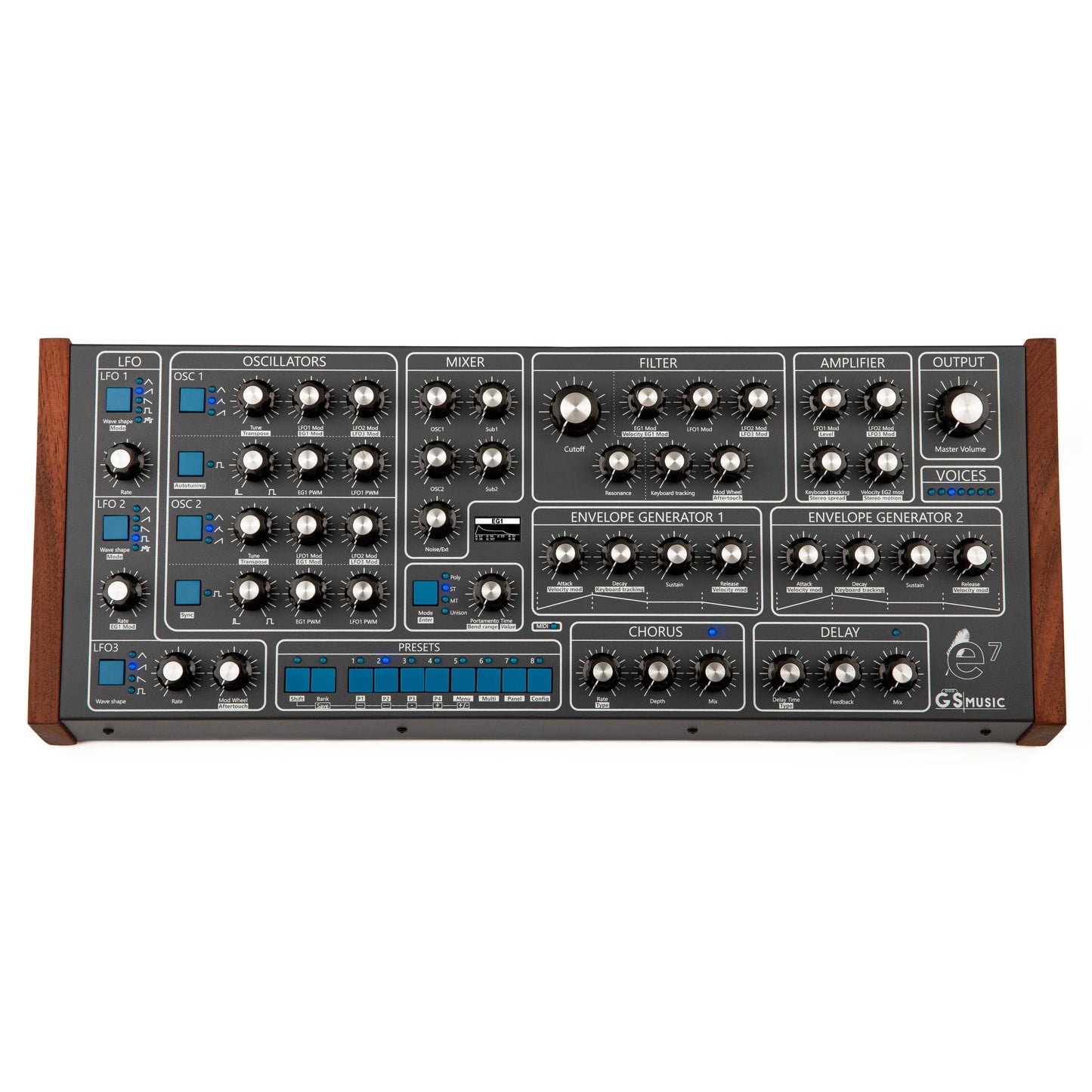
The GS e7 is a subtractive synthesis polyphonic analog synthesizer. The sound generation is carried out in a total analog way. Each voice has two voltage controlled oscillators (VCO), a noise source, a mixer, a voltage controlled filter (VCF) and a voltage controlled amplifier (VCA). The control signals are digitally generated by a microcontroller, which is capable of processing three low frequency oscillators (LFO) and two envelopes (EG) of the ADSR type. In addition, it incorporates an effects processor with chorus and delay.
The GS e7 interface was designed to be simple and intuitive.
It also has MIDI connections, USB, balanced stereo audio outputs, headphone output and CV inputs.
Signal path
The signal path is completely analog, featuring two VCO per voice, a white noise source, a mixer, a 4-pole low pass VCF and a VCA. The control voltages are digitally generated, including 3 LFO, 2 ADSR-type envelope generators. Finally, it has a stereo digital effects processor with Delay and Chorus. LFO 1, LFO2 and the delay can be synced with the MIDI clock using a user selectable subdivision.
Oscillators
It features two VCO plus sub oscillator per voice. Each oscillator has 3 different waveforms: triangle, sawtooth and saw-tri (triangle+sawtooth). There is a fine-tuning adjustment and a transpose option, allowing tune adjustment up to +/- 2 octaves. Tuning can also be modulated with any of the three LFOs and EG1.
Furthermore, each oscillator has a pulse wave that can be turned on or off, which is mixed with the other waveforms. Its pulse width can be modulated with LFO1 and/or EG1.
Oscillators can be hard synced, with oscillator 1 being the master and oscillator 2 the slave.
The autotuning algorithm takes about 2 seconds to complete. All the voices are tuned in parallel, making a lot faster than usual.
Mixer
The mixer can control the levels and mix the two oscillators, the suboscillators and the white noise or the external input (when the external input is connected, the white noise is disabled).
Filter
The filter is a 4-pole ladder-type low-pass filter with resonance control. It can be modulated with EG1, this modulation an also be affected by velocity. It can also be modulated with any of the 3 LFOs. On the other hand, it features keyboard tracking and it can be controlled by the modulation wheel or aftertouch.
Chorus
There are two types of chorus available: basic and ensemble. The Basic algorithm is subtle and allows you to add some spatiality tothe resulting sound, while the Ensemble algorithm adds a different dimension to the sound, simulating a string or vocal ensemble. The Basic algorithm uses two delay lines, while the Ensemble uses 4 delay lines. Each delay line has its own internal LFO. There are controls for rate, depth and mix.
Delay
The delay can be a stereo delay or a ping pong delay, with its maximum delay time being as long as 1.35s. It is possible to sync the delay to the MIDI clock too. If the delay is synced, the delay time knob controls the time division instead of the delay time. There are controls for the feedback and mix too.
LFOs
There are three LFOs available. LFO 1 and 2 have 5 waveshapes: triangle, ramp up, ramp down, square and random with sample and hold. LFO 3 has the first 4 waveforms and is activated with the modulation wheel and/or aftertouch.
LFO frequencies go from 0.1Hz to 100Hz. Additionally, LFO 1 and 2 have different modes:
Monophonic: The LFO is in phase for all of the voices.
Polyphonic: The LFO is generated to a slightly different frequency for all of the keys pressed. This allows an interaction of the phases, generating more complex modulations.
Keyboard Tracking (KB Tracking): The LFO frequency varies according to the note played following the chromatic scale.
Keyboard Sync (KB Sync): The LFO is restarted when a key is pressed. Each voice has its independent LFO.
Clock Sync: The frequency of the LFO is synced to the MIDI clock signal. The e7 automatically detects the BPM of the clock signal. It can be configured to generate different rhythmic figures.
Keyboard + Clock Sync: The LFO frequency will be a sub-division of the MIDI clock signal. Also, the LFO will be restarted each time a key is pressed.
Envelope generators
There are two ADSR-type envelope generators. There are controls for attack, decay, sustain and release. Attack and release can be modified by velocity and the envelope times have keyboard tracking.
Stereo
By default, the voices have a stereo panning from left to right. By adjusting the stereo spread, it is possible to set all voices to the center or set them from right to left. There is also a stereo motion option that allows this stereo spread to be adjusted by an LFO.
Presets
The synth can store up to 640 presets, 128 of them being multitimbral presets.
Multitimbral
The synth can have up to 4 multitimbral parts. Each part has its complete sound configuration, assignable MIDI channel, keyboard zone, velocity zone, transpose setting and MIDI filter. Additionally, each part can have different voice assignments and/or share some voices.
MIDI Polyphonic expression
MIDI Polyphonic expression is supported by the GS-e7. It was tested using GeoShred, allowing independent pitch control and cutoff for each voice.
Specifications
Specifications
Features
Features
Returns & Refunds
Returns & Refunds
Warranty
Warranty



Free UK Delivery
On any order over £150

Boutique Gear
The best brands from around the world

Visit Our Showroom
Test the latest gear and socialise in our store [Coming Soon]